Posts

Edward R Murrow Home
Image
Newsman. It evokes a certain image. Often a war correspondent writing his observations from a foxhole or a man in a trench coat and fedora with a cigarette dangling from his lips as he writes at an old-fashioned typewriter. Edward R. Murrow was just such a newsman. He was there at the very beginning of World War Two, he was there for the beginning of the television, he was there for the beginning of huge societal changes. From humble beginnings to the heights of network news, Murrow was the epitome of the American Dream. He rubbed shoulders with presidents and with privates. He saw the horrors of war and words failed him. You can hear Murrow’s show, I Can Hear It Now, and much more on the Murrow Collection . It is a fascinating to look into history and the evolution of network news.

Early Life Through College

Image
Born April 25, 1908 to Roscoe and Ethel Murrow in Polecat Creek, North Carolina,  Egbert Roscoe Murrow was the fourth son (the Murrow’s first son died) in his Quaker family. His older brothers were Lacey and Dewey. The family lived in a small log cabin with no running water or electricity. Roscoe Murrow worked very hard as a farmer bringing in only a few hundred dollars a year. Even though he was relatively successful, Roscoe longed for a different life. To that end, he moved his family across the country to a small town 30 miles south of the Canadian border, in Blanchard, Washington on Samish Bay. Roscoe went to work for the railroad eventually becoming a locomotive engineer—which he loved. During this time, Egbert changed his name and started going by Edward or Ed. Blanchard was very small with a very small school but the Murrow boys excelled. While in school Ed was in the school orchestra, glee club, played baseball and basketball as well as president of the student body. As if ...

Early Career

When Murrow and his fellow students graduated from college in 1930, the United States was seven months into the Great Depression. Interestingly, Murrow’s broadcasting career did not begin immediately after college. It may not have even entered his mind since radio was still exploring the boundaries. Instead, he went to work for the NSFA in New York City running the national office. After settling in at NSFA headquarters, Murrow was off to Europe for a meeting of the International Confederation of Students in Brussels, Belgium. The students attending the meeting were divided along country lines and no one could agree on anything. Actually, they did agree on one thing...to shun the German students in attendance. Murrow—with the sense of fairness instilled in him by his parents—made an impassioned speech to the assembly, telling them that they should not punish the students for the sins of their fathers. Once again, he brought the house down. The assembly was not so sure about the Germans...

World War II

Image
In 1937, CBS sent Murrow and his wife to Europe. CBS wanted to set up a network of reporters to provide first-hand observations of the changes in Europe. There was no network news at the time so there was no pattern to follow. Not only was there no pattern, Murrow had never been in the news business and never written a newspaper story. What he did know is how to organize people and work with people to get what he needed. In addition to setting up the reporting network, he was to schedule talks and set up interviews people with important people. But these interviews were for entertainment. News on the radio was limited to reading the news headlines on the hour by announcers. There was very little research and very little reporting on current events. His first hire was William L. Shirer , an American expatriate who worked all over Europe. Shirer’s hiring was Murrow’s first big test with the CBS brass. Shirer was no announcer, he was a newsman. The bosses back in New York thought hi...

World War II Reporter

Image
Murrow was not at all shy about where he had to go to get a story. He was not one of those reporters who only sat at a desk and delivered news written by someone else based on facts gathered by another person. From his signature, “This...is London” to the final “Good night and good luck”, he brought the action to the audience at home in the United States. One of his first reports from the middle of the action was during the Blitz in London. He provided a blow-by-blow account of the German bombs dropping on London. Reporting from the steps of St. Martins in the Fields on Trafalgar Square, with air raid sirens blaring in the background, he described in great detail the blackout. In other reports you can hear him talk about “bombs skittering”, hear the sound of explosions in the background and ack-ack exploding overhead. He flew 25 mission with both the RAF and the US Army Air Corp even though the honchos at CBS had a fit. This was an interesting take since his London office was b...

Post-War Radio

Image
Edward Murrow came home a changed man to a changed America. What now? That is the very same question millions of American, men and women, were asking themselves. Murrow helped transform news reporting just before and during the war and the things he saw and experienced changed him. Just as radio was forced to grow up rapidly, Murrow grew rapidly as a reporter. His broadcasts from Europe made him hugely popular at home in the United States but where was he to go from there?  - Old Radio Cat

I Can Hear It Now

Image
Over the course of his career, Murrow was never content just to sit back and report the news. He was aware that the news is also history. In the late 1940s, he recorded a series of records called I Can Hear It Now . The records were produced by Fred Friendly from a Rhode Island radio station. The records combined speeches and historical events with narration provided by Murrow. The series was so popular that CBS took notice, and since Murrow worked for CBS, they were able to strike a deal and bring the premise to radio. It was a little different for the time. They brought the stories to life by using recorded sounds like guns when presenting a story about war or aircraft when talking about aviation. I Can Hear It Now was presented in a magazine format which means that the show is divided into segments, and each story is presented in a dedicated segment. (You might be familiar with the format from television shows like 60 Minutes .) The  I Can Hear It N...

This I Believe

Image
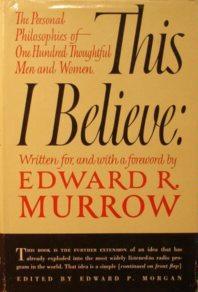
With a name like This I Believe and with the involvement from Edward R. Murrow, you might think that this show was an editorial platform for Murrow. However, it was not an editorial vehicle for Murrow. It was a show about Americans and their beliefs. In another, more cynical time, Murrow and This I Believe would probably be called naive, but with Murrow’s reputation for journalistic integrity, his unapologetic love for America, and the time period, it was a hit. He could see that, after the last war, and with the looming shadow of the Cold War, Americans needed to find themselves again. They needed to remember what they believe. The biggest problem he ran into was top management at his own network. They increasingly tried to control the editorial direction, continually placing yokes on the news division and trying to make sponsors happy. Eventually, out of several shows Murrow was pitching, the brass approved This I Believe. The show was about beliefs. Not religious beliefs but...

CBS University of the Air

Image
Murrow’s first involvement with CBS grew out of his NSFA presidency. In 1929, CBS started working with the NSFA to create the CBS University of the Air. The NSFA organized speakers and lessons to appear during the low-rated afternoon hours. In 1930, in his capacity as NSFA president, he also started working with CBS on the show. Murrow made his first radio appearance in September 1930 and, eventually, took over as the program host. He arranged for both international and American speakers like Mahatma Ghandi from London and former President Paul von Hindenburg from Berlin as well as Albert Einstein, Corliss Lamont and many more. Though Murrow eventually left the NSFA, he maintained his contact with CBS eventually going to work as the Director of Talks and Education.

Television

Image
While the beginnings of television started in the 1860s with the first cameras and progressed through the work of many people. However, television as we know it came about in the 1920s. Though TVs were commercially available in the 1920s and 1930s, they were not universally adopted. Like radio, people were not quite sure how to use TV. Entertainment was surely one use but there had to be a way to provide informative programming.

See It Now

Image
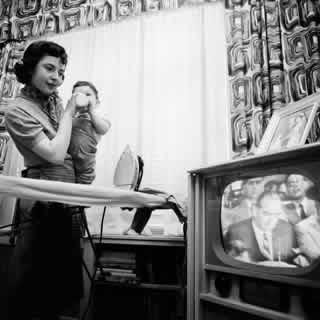
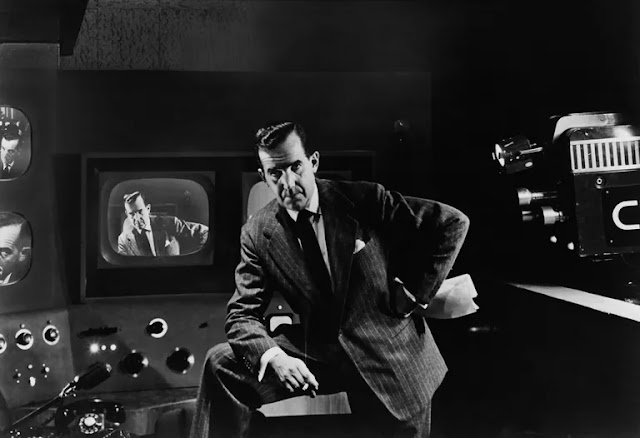
When Murrow came home he continued working in radio and knew nothing about television. Murrow certainly had no interest in television even saying that he wish it was never invented. Eventually, he was offered the opportunity to host a TV version of Hear It Now, along with producer Fred Friendly, called See It Now. Never one to sit back and wait for things to happen, Murrow went out to find the stories he wanted to tell. The See It Now team maintained a dedicated camera crew to film on location instead of relying on the companies that filmed the news reels. In another departure from accepted practice, the Murrow/Friendly team refused to rehearse interviews beforehand. Like in radio, Murrow came in and turned television on its collective ear. The regular American was always essential to Murrow and that is who he wanted to know more about. Plenty of other outlets covered celebrities and politicians, it was the everyday man and woman Murrow wanted the world to know. He also wanted to sho...

Edward R Murrow Sign Off: "Good Night and Good Luck"

Image
“Good night and good luck” was Edward R. Murrow’s famous sign off. He ended his reports from Europe that way, implementing it in 1940 on a broadcast from London. In addition to the famous Edward R. Murrow sign off was his sign on for his early reports: “This...is London,” or whatever city he was in at the time. Both of these catch phrases helped make Murrow an icon in broadcasting history. Murrow’s sign off was as famous as that of just about any broadcast journalist.   Other well-known sign off phrases include Walter Kronkite’s “and that’s the way it is,” Paul Harvey’s “Good Day,” and Linda Ellerbe’s “and so it goes.”

Edward R. Murrow Movie

Image
Good Night, and Good Luck , the 2005 box office blockbuster, looks at Edward R. Murrow’s epic battle against the commie-hunting Senator, Joseph McCarthy. David Strathairn (The Bourne Ultimatum) played Murrow, while Jeff Daniels and Robert Downey, Jr. also starred. George Clooney wrote and directed, while also playing the role of Fred Friendly. Good Night, and Good Luck   movie is about Murrow’s idealism was nominated for six Oscars and won the 2005 AFI Film Award for AFI Movie of the Year. Edward R. Murrow is the subject of other movies available at video stores and via online video rental services. Edward R. Murrow: The Best of “See it Now”  Edward R. Murrow: The Best of “Person to Person”  Edward R. Murrow: The McCarthy Years ,  These above are all compilations of the famed reporter’s work, while This Reporter and Harvest of Shame are documentaries on his life and career.

Edward Murrow Speech

Image
On Oct. 15, 1958, Murrow gave a controversial speech that would live on in history for its candid nature, and for its success in dressing down the broadcast journalism industry. It is sometimes called the “wires and lights in a box speech.” Murrow was asked to give the keynote address at the ‘58 Radio-Television News Directors Association convention. He reluctantly agreed, mounted the dais, and proceeded to breath fire, dismantling the industry as lacking in values, not standing up to corporate interests, and betraying the trust of the American people with their watered-down reporting. Early in the speech, Murrow intoned, “If there are any historians about 50 or 100 years from now, and there should be preserved the kinescopes for one week of all three networks, they will find there recorded in black and white, or color, evidence of decadence, escapism, and insulation from the world in which we live.” He later said “I would like television to produce some itching pills rather than t...

McCarthy Era

Image
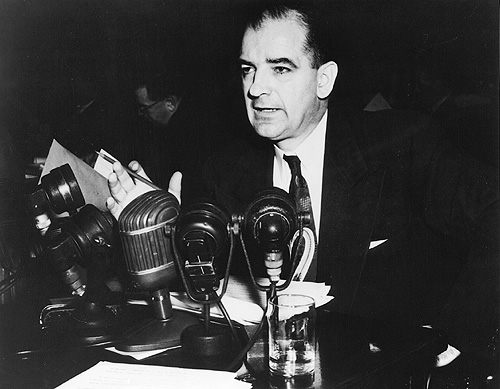
Click here for over 4 hours  of McCarthy Era Recordings Joseph McCarthy was the junior senator from Wisconsin for 10 years from 1947 until his death in 1957. McCarthy was born in 1908 on a dairy farm, went to college and earned a law degree from Marquette in 1935. In 1939 he became the youngest elected judge in state history, clearing a massive backlog of cases. When war began, McCarthy left his judgeship and joined the Marines, working mostly in intelligence though he did earn the nickname Tail-Gunner Joe for flying 12 observer missions in the tail-gunner position. After the war, McCarthy ran for senate against Robert M. La Follette, Jr, and won, mostly using innuendo and half-truths to defeat his opponent. He started his senate career in 1947. The first three years were pretty unremarkable. In 1950, however, at a speech in Wheeling, West Virginia, McCarthy started making his mark as an anti-Communist crusader. He claimed to have a list of Communists working in the State...

Edward Murrow Challenges Joseph McCarthy

Image
Using partial truths, distortions, and some flat out lies in speeches and in hearings, McCarthy was a poster child for people who saw Communist conspiracies everywhere. On the March 9, 1954 episode of See It Now, Murrow systematically countered the charges McCarthy made in public. During the show, Murrow played clips of McCarthy making charges and then answered him using McCarthy’s own words. Public opinion was starting to turn and seemed to turn faster after the show. McCarthy was not happy. Because of the Fairness Doctrine, CBS was required to provide a half hour to McCarthy so he could provide a rebuttal. Murrow was a newsman who was confident and had his facts together. In contrast, McCarthy was uncomfortable and, as he tended to do in many situations, made wild accusations. McCarthy’s appearance on the show did him no favors. In the final public salvo between the newsman and the senator, Murrow responded to the specific accusations made against him. Again, McCarthy used par...

McCarthy: The Finale

Image
McCarthy had his supporters, and he still does. One of Murrow’s issues with McCarthy is that he did not try to engage in true investigation and he tried to silence his critics with accusations. He did not participate in debate and dialog to find the truth. Had he sat down with Murrow, he would have found another person who believed that communism was a threat. As a result of his behavior, Joseph McCarthy was censured by the Senate on December 2, 1954. He died in office in 1957 without ever regaining his reputation.

Cold War

Image
The Cold War was all-consuming during the 1950s. It started just after World War 2 when the Russians developed the atomic bomb and tensions increased between the Western world and the Communist Eastern Bloc. The tension between the two blocs increased with the Korean War to the point that people were truly and seriously scared. There were bomb drills all over the United States. As with most anything, good or bad, there is someone who will take advantage of the situation for personal gain. Enter Senator Joseph McCarthy .

Late Career

Image
Immediately after World War 2, Murrow had several different job offers from academia to government. He eventually decided to stay at CBS as Vice President of CBS, Director of News and Public Affairs. This was in 1946, but by 1947, he discovered that pushing a pencil was not for him so he went back to what he loved...news. From 1947 until 1961, Murrow worked as a news man. In addition to See It Now and This I Believe, he was a news analyst for CBS News, Person to Person , CBS Reports, Small World, and more. As with everything else in the world, nothing stays the same. Murrow had his ideas about how the news should run. It should be free from influence, from the network or sponsors, and you must always, always tell the truth. CBS corporate and sponsors chaffed at Murrow’s independence. He had no qualms about criticizing sponsors or his industry. As the television industry grew, the news divisions gave way to entertainment. The entertainment side of the business brought in the m...

Case of Milo Radulovich

Image
Milo Radulovich was discharged from the Air Force Reserve presumably because some members of his family had Communist sympathies. He was given the opportunity to resign but refused and requested a hearing. During the hearing, the prosecution waved around a sealed manila envelope claiming there was evidence in it but it was never opened. Though Radulovich was severed from the Air Force, the lieutenant’s loyalty was never questioned. The case came to the attention of Murrow’s producer, Fred Friendly, and Murrow through an article in the Detroit Press. The duo searched for a story to illustrate the dangers of McCarthyism. Not only were the witch hunts affecting the military, Hollywood, government, and academia, this case proved that the average guy can be targeted. The entire case was based on Radulovich’s father and sister. Emigrants from Serbia, his father subscribed to several Serbian newspapers, one of which was classified as Communist by the US government. In addition his sister was...